From Crushing to Granulation: High-Efficiency Plastic Recycling Line Design and Flow
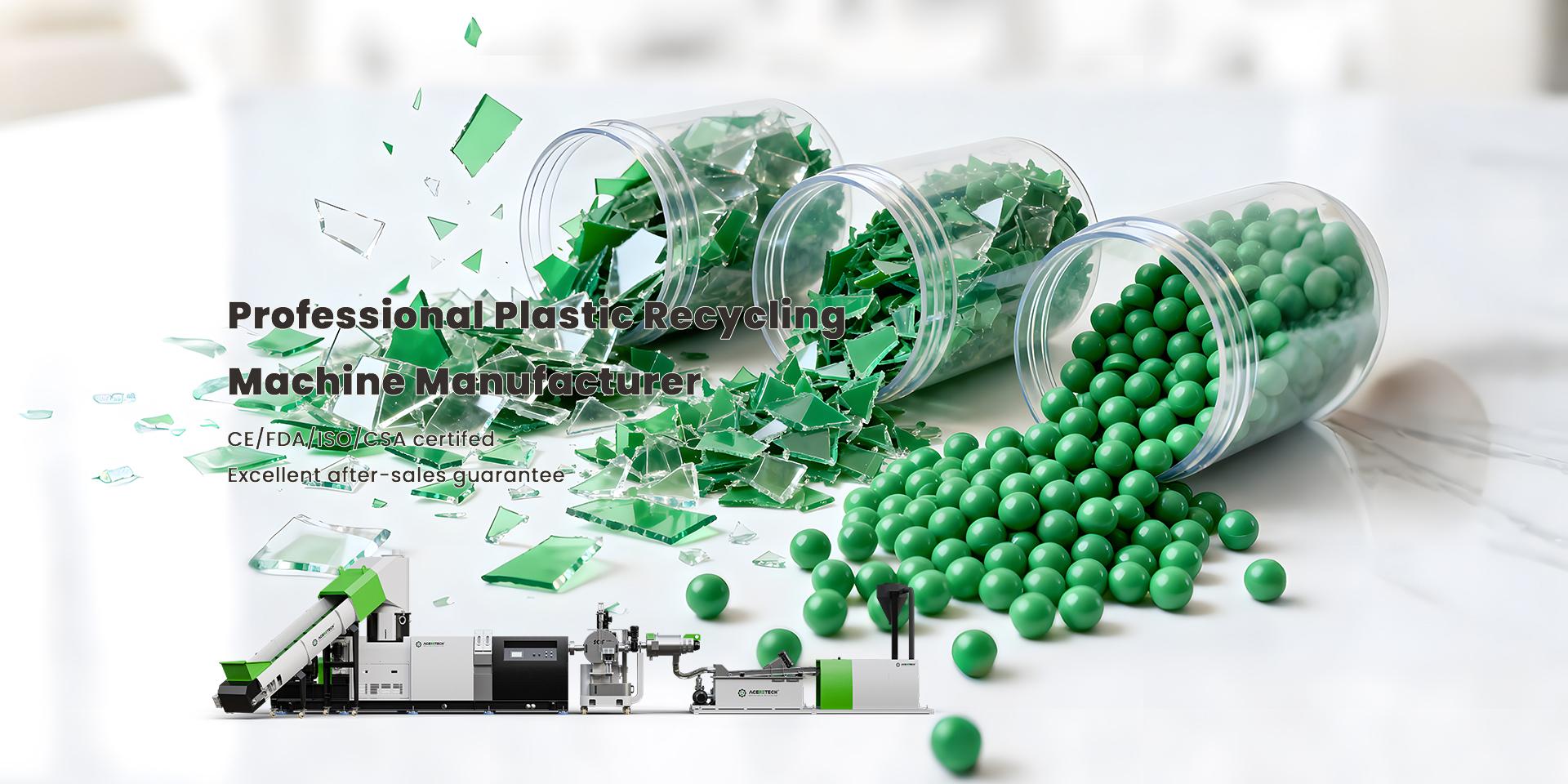
ACERETECH Machinery specializes in the research, development, and manufacturing of waste plastic recycling equipment. We are committed to providing global customers with a full range of waste plastic treatment solutions, covering the shredding, crushing, cleaning, granulation, and food-grade PET recycling of waste plastics. Our mission is to make plastic recycling simpler and more efficient. With the power of technological innovation, ACERETECH offers a one-stop whole-plant planning service and personalized recycling solutions to meet customer demands, no matter how complex the plastic recycling challenges may be.
Our integrated recycling lines are designed to handle a wide variety of materials, including LLDPE/LDPE/HDPE/EPE film, PP/OPP/BOPP film, PET bottle flakes, HIPS/PC/ABS home appliance housing, and engineering plastics.
The Modular Design Approach: Maximizing Output Value
Successful recycling operations require a holistic approach where the performance of each module directly impacts subsequent stages. At ACERETECH, our strategic framework focuses on achieving optimal output value rather than mere production volume. This modular design approach ensures that recycling facilities can handle diverse plastics and achieve optimal efficiency and ROI.
A complete recycling line integrates six critical stages: Crushing → Washing → Dewatering → Drying → Pelletizing/Filtering → Discharge.
Key Principles of Modular Design
-
Strategic Alignment: The conceptual design focuses on clear operational parameters across all modules, allowing the flexibility for material-specific adjustments while maintaining efficiency.
-
Scalability and Flexibility: Modular designs allow for easy scaling and upgrades, which is crucial for handling fluctuating waste volumes and adapting to regulatory changes or new technologies like chemical recycling.
-
Efficiency and Reliability: The layout is optimized to minimize material handling, reduce transport distances, and streamline flow, potentially reducing energy consumption by 15–25%.
Typical Workflow Layout: A Complete Recycling Line Process
A standard high-efficiency layout typically arranges modules in a linear or U-shaped flow to optimize space and material flow for throughput capacities ranging from 2 to 5 tons per hour. The workflow is structured around continuous material transformation:
| Stage | Function | Design Focus | Key Parameters |
| Crushing | Size reduction to prepare plastics for washing and subsequent processing. | Feeding consistency, robust cutters. Achieves 90-95% size consistency. | Reduces plastics to uniform flakes (e.g., 40mm). Energy Use: 50-70 kWh/ton. |
| Washing | Removal of contaminants (labels, dirt, adhesives) with water and specialized chemicals. | Closed-loop water system, multi-stage washing (sink-float, friction washers). | Removes 95-99% contaminants. Water reuse up to 80-90%. |
| Dewatering | Mechanical moisture extraction to reduce moisture content before thermal drying. | High-capacity centrifuges or squeeze drying. Focus on vibration dampening for 24/7 operation. | Achieves <5% residual moisture. High-Speed Centrifuges operate at 1000–1500 RPM. |
| Drying | Final moisture elimination, which is critical for quality pelletizing and preventing clumping. | Thermal efficiency, convection/infrared drying options. Insulated chambers to minimize heat loss. | Reduces moisture to <1% (or under 0.5% for high-grade pellets). |
| Pelletizing/Filtering | Melts, filters, and homogenizes plastics to produce uniform, high-purity granules. | Adjustable screw speed, continuous backflush filters, customized screw geometry. | Produces granules at 95% purity. Extruder temperatures vary by polymer type (e.g., PP: 145°C-170°C). |
| Discharge | Final output, granule collection, sizing, and packaging. | Automated pellet conveyors, minimal contamination risk, dust collection. | Uses vibrating sieves for size classification. Output packaging with low energy use (20-30 kWh/ton). |
Key Nodes and Critical Design Points
Optimizing each key node is essential for achieving the high efficiency and low energy consumption necessary for modern recycling operations.
- Size Reduction (Crushing/Shredding)
Size reduction is the critical first step that determines downstream efficiency.
• Design Point: Rotor and Blade Configuration: We recommend staggered rotors and heavy-duty grinders to handle mixed rigid and flexible plastics effectively, reducing wear by 25%. This ensures the output particle size distribution is optimized for washing efficiency.
• Design Point: Integration and Safety: Throughput capacity must be matched to the overall line capacity. Safety features should include overload sensors to prevent jams and extend machine life by 30%. Effective dust containment systems are necessary for workplace safety and material loss prevention.
- Washing and Contaminant Removal
Effective washing transforms contaminated post-consumer plastic into clean flakes suitable for pelletization, directly impacting final pellet quality and the need for downstream filtration. Acewash, a key member of the ACERETECH Group, focuses specifically on R&D and production of efficient plastic washing lines.
• Design Point: Multi-Stage Cleaning: Combine sink-float tanks with friction washers for layered cleaning. For challenging materials like PP plastics, specialized washing may involve chemical assistance (such as specialized solvents or alkaline detergents) to remove contaminants effectively.
• Design Point: Water Management: Integrate filtration systems to implement closed-loop water recycling, which can reduce freshwater usage by up to 90%.
- Dewatering and Drying Systems
Efficient moisture removal prevents downstream processing issues and significantly reduces energy consumption during the extrusion phase, as inadequate drying consumes disproportionate energy.
• Design Point (Dewatering): Utilize high-speed centrifugal dewaterers (spinning at 1000–1500 RPM) to rapidly extract moisture, achieving less than 5% residual water content. Auto-Discharge mechanisms should be included to prevent blockages.
• Design Point (Drying): Employ highly efficient systems like infrared options (which are faster than convection, saving 20% time) or insulated thermal dryers that reduce moisture to below 1%. Real-time moisture sensors allow for precise process adjustments and consistency.
- Extrusion, Filtration, and Pelletizing
This final stage determines the commercial value of the recycled plastic. ACERETECH provides advanced Recycling Pelletizing Systems.
• Design Point: Extruder Technology: Utilize single or twin-screw extruders to melt and homogenize the material. Customized screw geometry is essential for specific polymer types (e.g., PP, PET, HDPE) to avoid degradation.
• Design Point: Advanced Filtration: Filtration systems must remove remaining contaminants. We employ advanced features such as automatic screen changers for continuous operation, backflush capability for extended periods, and pressure monitoring to match the filtration fineness to application requirements.
• Design Point: Pellet Formation: Use water-ring cutters or other precision pelletizing systems to form uniform pellets. For instance, pelletizers use rotating cutting knives adjusted by motor speed to control particle length. Vacuum degassing can also be integrated for odor removal.
- Discharge (Output Management)
The final node ensures the quality granules are handled efficiently and packaged with minimal contamination risk.
• Design Point: Classification and Handling: Multi-deck vibrating sieves are incorporated for accurate size classification. Automated packaging integration, linked to silos, allows for bulk handling and streamlined logistics.
• Design Point: Cleanliness: Enclosed conveyor systems and dust control are implemented to meet health standards and prevent contamination at the final output stage.
Critical Design Considerations Across the Line
To achieve truly high-efficiency results, ACERETECH emphasizes integrated control and optimization across all modules:
• Automation and IoT Monitoring: We incorporate PLC controls and IoT monitoring for predictive maintenance, which can reduce downtime by up to 40%. Automation controls are applied to vacuum, extrusion parameters, degassing, and filter changes to ensure consistent pellet quality.
• Energy Efficiency: Implementation of energy-efficient motors (such as IE4 standard) helps cut power consumption by 10–15%. Utilizing heat recovery systems and optimizing thermal insulation on extruders and dryers can reduce overall energy consumption by 20–30% in typical operations.
• Quality Assurance: Quality control systems should implement regular testing protocols for crucial parameters such as Melt Flow Index (MFI) for processability consistency, contamination levels (monitored via filtration pressure), and moisture content.
By adopting these high-efficiency design recommendations, recycling operations can align with the growing global demand for recycled plastics, improve yield efficiency, and secure a competitive advantage in the market. ACERETECH is dedicated to offering specialized, customizable solutions that enhance modularity, automation, and sustainability for diverse recycling challenges